Gum Disease Stages, Treatment Costs, and What Happens If You Wait
Cavities and Fillings Material Options, Costs, and How Long Each Lasts
Canker Sores Symptoms, Causes, and How to Manage Them
Invisalign VS Traditional Braces Which Orthodontic Treatment is Right for You
Root Canal Cost What the Procedure Involves and What to Expect
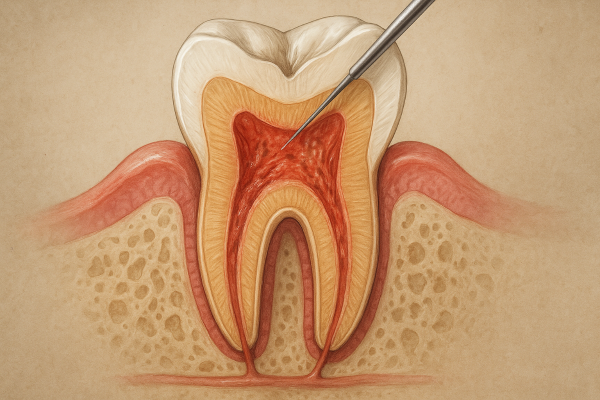
A root canal is an endodontic treatment used to save a tooth when the soft tissue inside it, called the pulp, becomes infected or inflamed. The dentist removes the damaged pulp, cleans and shapes the internal canals, then seals them to prevent further infection.
Despite its reputation, the procedure itself is performed under local anesthesia and is generally comparable to having a filling placed. The larger question for most patients is cost, and that figure varies considerably depending on which tooth is involved, who performs the treatment, and whether a crown is needed afterward.
What a Root Canal Costs by Tooth Type
Price is driven primarily by tooth position, because back teeth contain more canals and are harder to reach. Front teeth typically have a single canal, while molars often have three or four.
Based on 2026 US pricing data, typical costs without insurance fall roughly as follows: front teeth, meaning incisors and canines, run about $620 to $1,100. Premolars, sometimes called bicuspids, run about $720 to $1,300. Molars run about $890 to $1,500, and complex molar cases can exceed that.
Across all tooth types, the commonly cited national range is $700 to $1,600 without insurance. With dental coverage, typical out-of-pocket costs fall to roughly $200 to $900 depending on plan design and remaining annual maximum.
The Crown Is a Separate Cost
This is the line item patients most often miss when budgeting. A tooth that has had a root canal is more brittle than a healthy tooth, because the pulp that once supplied it has been removed and a portion of the tooth structure was drilled away for access.
Back teeth almost always require a crown afterward to prevent fracture. A crown typically adds $800 to $2,500, with a national average near $1,300. That brings the realistic all-in cost of a molar root canal with a crown to roughly $1,700 to $3,200.
Some front teeth can be restored with a filling instead of a crown if enough healthy structure remains. Ask specifically whether a crown is part of the plan and whether it is included in the quoted price, because practices differ on how they present this.
What the Procedure Actually Involves
Treatment usually takes one or two visits. The dentist numbs the area, isolates the tooth with a rubber dam, and creates an opening through the crown of the tooth to reach the pulp chamber.
The infected tissue is removed with fine instruments, the canals are cleaned and shaped, and the space is disinfected. The canals are then filled with a rubber-like material called gutta-percha and sealed. A temporary filling closes the access opening until the permanent restoration is placed.
Patients commonly report mild soreness for a few days afterward, generally manageable with over-the-counter pain relievers. Significant pain, swelling, or a return of symptoms after treatment should be reported to the dental office promptly.
General Dentist or Endodontist
Many general dentists perform root canals routinely, particularly on front teeth and premolars. An endodontist is a specialist who has completed additional years of training focused specifically on this type of treatment.
Specialists typically charge more, often 20 to 40 percent above a general dentist for the same tooth. That premium can be worthwhile for molars, retreatment of a previously treated tooth, unusual canal anatomy, or cases where the first attempt did not resolve the problem.
A reasonable approach is to ask your general dentist directly whether your case is one they treat routinely or one they would refer. Most will tell you honestly, and a referral is not a sign that something is unusually wrong.
Root Canal Versus Extraction: Comparing the Real Numbers
Extraction looks cheaper at first glance. A simple extraction runs roughly $150 to $300, and a surgical extraction of an impacted or broken tooth can reach $800. Compared with $1,700 to $3,200 for a root canal and crown, the gap seems decisive.
The comparison changes once replacement is factored in. An extracted tooth leaves a gap, and gaps cause neighboring teeth to shift and the supporting bone to resorb over time. Replacement options and their typical costs:
- Single dental implant: roughly $3,000 to $6,000, with a national average near $4,500.
- Three-unit bridge: roughly $2,000 to $5,000, averaging near $3,500, and it requires reshaping the two adjacent healthy teeth.
- Partial denture: less expensive up front but removable, and it typically requires periodic adjustment or replacement.
- No replacement: no immediate cost, but shifting teeth, bite changes, and bone loss can create larger expenses later.
Over a five to ten year horizon, saving the natural tooth is usually the less expensive path as well as the more conservative one. The exception is a tooth that is badly fractured, has insufficient remaining structure, or has severe bone loss around it, where the dentist may judge it not restorable.
How Insurance Typically Handles Root Canals
Most dental plans classify root canals as a major or basic restorative service, commonly covering 50 to 80 percent after any deductible. Crowns are usually classified as major and covered at around 50 percent.
The constraint most patients run into is the annual maximum, which commonly falls between $1,000 and $2,000. A root canal plus crown can consume an entire year's benefit on a single tooth, which matters if other work is planned.
Two practical points. If treatment is not urgent and your annual maximum is nearly exhausted, ask whether the root canal can be completed this year and the crown early next year, which splits the cost across two benefit periods. And if you have a waiting period on major services, confirm whether it has elapsed before scheduling.
Questions to Ask Before You Agree to Treatment
- Which tooth is being treated, and how many canals does it have? This drives the price more than anything else.
- Is a crown included in the quoted figure, or is it billed separately?
- Will this be done in-house or referred to an endodontist, and how does that change the cost?
- What is the estimated insurance portion and my estimated out-of-pocket amount in writing?
- What happens if the tooth cannot be saved once treatment begins, and how is that handled financially?
- Does the practice offer in-house payment plans, and does it accept third-party healthcare financing?
What Happens If Treatment Is Delayed
An infected pulp does not resolve on its own. Pain may subside temporarily when the nerve tissue dies, which some patients interpret as improvement, but the infection continues in the surrounding bone.
Untreated infection can progress to an abscess, spread into surrounding tissue, and in uncommon cases cause serious systemic complications requiring emergency care. It can also destroy enough bone and tooth structure that the tooth becomes unrestorable, converting a $1,200 problem into a $4,500 one.

If you are delaying because of cost, say so directly to the dental office. Many practices offer payment arrangements, and some can prioritize stabilizing the infection while the restoration is scheduled later.
Ways to Reduce the Cost
Dental schools with accredited programs often provide treatment at substantially reduced fees, performed by students under faculty supervision. Appointments take longer but the savings can be significant.
Community health centers and Federally Qualified Health Centers frequently offer sliding-scale fees based on income. Dental savings plans, which are discount programs rather than insurance, typically charge an annual membership fee and provide reduced rates at participating providers with no waiting periods or annual maximums.
Comparing written estimates from two or three practices is also worthwhile. Fees for identical procedures vary meaningfully within the same city, and the range is wider than most patients expect.
Success Rates and How Long Treatment Lasts
Root canal treatment has a high success rate, with most studies placing it well above 90 percent for teeth that are properly restored afterward. A treated tooth can function for decades and in many cases for the rest of a patient's life.
The most common reason treatment fails is not the endodontic work itself but the restoration. A tooth left with a temporary filling for months, or restored with a filling when a crown was needed, is at high risk of fracture or reinfection. Completing the permanent restoration promptly is the single most important factor within your control.
Where a previously treated tooth develops symptoms again, retreatment is often possible. This involves removing the existing filling material, re-cleaning the canals, and resealing. It typically costs more than the original treatment, commonly $900 to $2,000, because the work is more complex.
What Recovery Actually Looks Like
Most patients return to normal activity the same day. Numbness from local anesthesia wears off over a few hours, and it is sensible to avoid chewing on that side until sensation returns to prevent accidentally biting the cheek or tongue.
Mild tenderness when biting on the treated tooth is common for several days and occasionally up to a week or two, particularly if there was significant infection beforehand. Over-the-counter anti-inflammatory medication generally manages this well.
Avoid chewing on the treated tooth until the permanent restoration is placed, since a tooth with a temporary filling is vulnerable to fracture. Contact the dental office if pain increases rather than decreases after the first few days, if swelling develops, or if the temporary filling comes out.
Common Myths Worth Correcting
- Root canals are extremely painful. Modern anesthesia makes the procedure comparable to having a filling. The pain patients remember is usually the infection beforehand, which the treatment resolves.
- A tooth that does not hurt does not need treatment. Pain often stops when the pulp dies, while the infection continues in the bone.
- Extraction is simpler and cheaper. It is cheaper on the day and usually more expensive once replacement is accounted for.
- Root canals cause systemic illness. This claim originates from research from the early twentieth century that has been thoroughly discredited, and no credible current evidence supports it.
- A crown is optional. On molars it rarely is, and skipping it is the most common cause of a failed root canal.
Making an Informed Decision
Root canal treatment is a well-established procedure with high success rates, and in most cases it preserves a natural tooth that would otherwise be lost. The cost is real, but so is the cost of the alternative once replacement is accounted for.
Request a written estimate that separates the endodontic treatment from the restoration, confirm what your plan covers, and ask about payment options before scheduling. Understanding the full picture in advance makes the decision considerably easier than sorting it out from the dental chair.